Buscar

Mostrando las entradas con la etiqueta Economy. Mostrar todas las entradas

viernes, febrero 18, 2022

INRA now says Mennonite colony is legal and was 'victim' of land trafficking

 The agrarian entity affirms that the colonists must move back more than 2,000 hectares because they occupy a property ceded to Iniaf and a community of which there are no records of activity. It gave 15 days for the Mennonites to vacate this space.

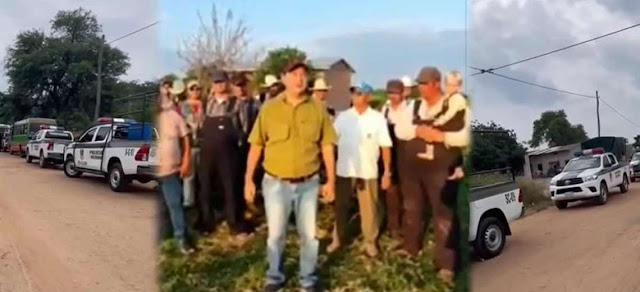
Contradictions arise that cast doubt on the real motives for the eviction of the Valle Verde Mennonite community, located in the locality of Quimome in the municipality of San José de Chiquitos. After describing this group as illegal and calling them foreigners, yesterday the National Institute of Agrarian Reform (INRA) assured that their settlement is legal, but that it exceeded its extension, so they will only have to move their colony to more than 2,000 hectares. In addition, it implied that the group was a victim of land trafficking and urged them to follow the corresponding legal measures.

However, the entity was categorical in stating that the community must abandon the disputed space that was granted as usufruct to the National Institute for Agricultural and Forestry Innovation (Iniaf) (860 hectares) and another part ceded to the 19 de Noviembre community with 1,400 hectares.

It is legal

In declarations to Bolivia TV, the national director of INRA, Eulogio Núñez, assured that the Mennonite colony is legal, but that it extended its limits over a fiscal property and that the solution to the conflict is to move its community.

"They simply have to move back a little bit to their colony, which is legal. What has happened is like an overflow of this colony, which suddenly also encroached on lands that were in usufruct of the Iniaf and of this community that is authorized," he remarked.

In another interview with Bolivia TV, the director of INRA in Santa Cruz, Adalberto Rojas, like Núñez, recognized that the Mennonite community is legal and that it has more than 7,000 hectares.

He assured that the eviction is from the occupied public lands and that they will not be left without land, because "nobody will take anything from them".

By means of a communiqué, yesterday the entity reiterated the measure and said that "there are pending tasks concerning inventories and removal that in a maximum period of 15 days must be concluded, according to the commitment subscribed by the occupants. These actions will be carried out under the supervision of INRA and police protection".

In addition, the entity assured that if some of the evicted Mennonites were victims of land trafficking, they must make the corresponding resignation.

"If the evicted Mennonites had been victims of land trafficking, they should go to the ordinary justice system for investigation and application of criminal sanctions, if appropriate," the entity assured in its statement.

It also assured that the 19 de Noviembre community has a Settlement Authorization Resolution issued on February 18, 2016.

However, the Mennonites' lawyer, Alejandro Altamirano, specified that INRA itself revoked this settlement. 

"The same agrarian entity carried out an on-site inspection and found that the farmers did not work the land, so it totally annulled the settlement permit," he explained and maintained that

the expansion was not irregular, but in 2009 they bought the 2,000 hectare property called Guayacanes from a couple.

This couple even had documentation dating back to 1992, when Iniafa did not exist. So, he assured that the communities have all the documentation that supports the operation.

"This is a political issue and what is intended is to settle an intercultural community November 19. That is what is happening. The community has not been able to be evicted," he said.

He added that if what Núñez said was true, "the agrarian file should have been annulled". "Subsequently, the cancellation of the registry where the name of the legal representatives of the registry is registered in the Real Rights Registry should have been made". 
INRA now says Mennonite colony


domingo, febrero 13, 2022

After 2 years of neglect, maintenance of the Casa Grande costs Bs 1.5 million

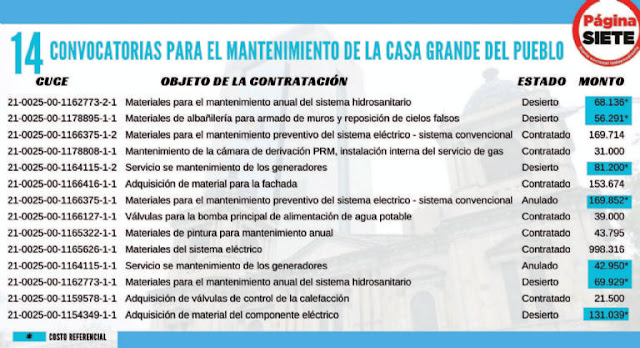
 During 2021, 14 processes were published in the State Procurement System for the purchase of spare parts, but only seven were awarded. The rest were declared void or were annulled. 

After four years of its opening, and two of neglect, part of the maintenance of the Casa Grande del Pueblo costs 1.5 million bolivianos. This figure does not include the contracts that are still pending, those that have been canceled and some that have been declared void.

Between August and December 2021, the Ministry of the Presidency published, in the State Contracting System (Sicoes), 14 contracts referring to the maintenance of government infrastructure. Of these, seven were awarded and six were declared void or canceled from the call.

The purpose of the contract is the purchase of supplies for the maintenance of the electrical system, the hydro-sanitary system, the façade or the heating. The number of contracts and their value is lower compared to those made in 2019, when all the floors and offices of the building were still equipped and put into operation.

Although the building is still new, it is highly used and already generates several complaints. Some of them are due to the detachment of the facade and certain damage to the hydro-sanitary system.

two years of carelessness

The government building was inaugurated on August 8, 2018. Its construction was declared a national priority in 2012, through Law 313. The contract that began the works, in 2015, stipulated that the 29-story building and a heliport should be delivered in 2016.

However, the terms and costs changed in five modified contracts. Between the first and the last there is a difference of 9.9 million Bolivians.

For its equipment and decoration, more than 34 million Bolivians were allocated. The amount included a bed of more than 21,000 bolivianos and dishes of more than 33,000.

The then president, Evo Morales, promoter of the project, occupied the presidential floor and governed from that building until his resignation in 2019.

After his departure, former temporary president Jeanine Añez decided to return the presidential offices and rooms to the former Government Palace and the San Jorge residence, respectively. Only the floors that housed five ministries remained in operation.

It was during the hard times of the pandemic that it was decided to install a control and coordination center for the fight against covid in Morales' suite, and on floors 22 and 23.

From the beginning of the transition in November 2019, until its departure in November 2020, there were no purchases of supplies or services for maintenance.

These were not taken up again until the second half of 2021, during the Luis Arce administration. The president returned the presidential offices to the new premises. It should be noted that Arce does not reside in the suite of the Casa Grande del Pueblo or in the residence of San Jorge. He preferred to keep his home in Miraflores, within the framework of his austerity policy.

After four years of its opening, and two of neglect, part of the maintenance of the Casa Grande del Pueblo costs 1.5 million bolivianos. This figure does not include the contracts that are still pending, those that have been canceled and some that have been declared void.

Between August and December 2021, the Ministry of the Presidency published, in the State Contracting System (Sicoes), 14 contracts referring to the maintenance of government infrastructure. Of these, seven were awarded and six were declared void or canceled from the call.

The purpose of the contract is the purchase of supplies for the maintenance of the electrical system, the hydro-sanitary system, the façade or the heating. The number of contracts and their value is lower compared to those made in 2019, when all the floors and offices of the building were still equipped and put into operation.

Although the building is still new, it is highly used and already generates several complaints. Some of them are due to the detachment of the facade and certain damage to the hydro-sanitary system.

two years of carelessness

The government building was inaugurated on August 8, 2018. Its construction was declared a national priority in 2012, through Law 313. The contract that began the works, in 2015, stipulated that the 29-story building and a heliport should be delivered in 2016 .

However, the terms and costs changed in five modified contracts. Between the first and the last there is a difference of 9.9 million Bolivians.

For its equipment and decoration, more than 34 million Bolivians were allocated. The amount included a bed of more than 21,000 bolivianos and dishes of more than 33,000.

The then president, Evo Morales, promoter of the project, occupied the presidential floor and governed from that building until his resignation in 2019.

After his departure from him, former temporary president Jeanine Añez decided to return the presidential offices and rooms to the former Government Palace and the San Jorge residence, respectively. Only the floors that housed five ministries remained in operation.

It was during the hard times of the pandemic that it was decided to install a control and coordination center for the fight against covid in Morales' suite, and on floors 22 and 23.

From the beginning of the transition in November 2019, until his departure from him in November 2020, there were no purchases of supplies or services for maintenance.

These were not taken up again until the second half of 2021, during the Luis Arce administration. The president returned the presidential offices to the new premises. It should be noted that Arce does not reside in the suite of the Casa Grande del Pueblo or in the residence of San Jorge. He preferred to keep his home in Miraflores, within the framework of his austerity policy. 

Casa Grande costs Bs 1.5 million

domingo, febrero 06, 2022

Arce reports that they found 350 billion cubic feet of gas in Margarita-Huacaya

 He said that when the government took office he found the hydrocarbon sector deteriorated, there was no investment and the exploration that was being carried out, unfortunately, had not produced results.

President Luis Arce reported this Saturday the discovery of a gas reserve of between 300 and 350 billion cubic feet of gas in the Margarita-Huacaya well, as a result of exploration work that began last year.

Arce released the information during the delivery of a drinking water system in Coipasa, a municipality of the same name in the department of Oruro, where he stressed that this work began in his management and the results were immediate.

He said that when he assumed the government he found the hydrocarbon sector deteriorated, there was no investment and the exploration that was being carried out, unfortunately, had not yielded results.

“Last year we started an exploration in the Margarita Huacaya well, in our government. That well is giving us good results, we are finding gas reserves, in this well that we explore in our management, in the order of 300 to 350 billion cubic feet”, he stated.

He assured that this deterioration will gradually be reversed because the reserve found will begin to be exploited, which will also mean higher IDH income for mayors and governors.

He indicated that the country will begin to have the capacity to export gas to generate greater economic income for the country.

"That is the great news that we wanted to give," said the president who is visiting Oruro on the occasion of the start of his anniversary on February 10.

Presidente Arce

viernes, enero 28, 2022

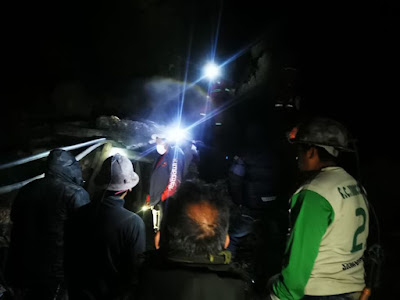
Two other workers were crushed to death in the Cerro Rico mine

 When we are still in January, there are already nine miners who die due to industrial insecurity in the cooperatives. 

When we are still in January, there are already nine miners who die due to industrial insecurity in the cooperatives.

Two workers are added to the list of dead miners in the mining deposits of Cerro Rico de Potosí. There are already nine deaths due to instability in the sinkholes in 26 days of this administration.

The departmental deputy commander of the Police, José Luís Assaf, confirmed the death of the 30 and 40-year-old workers in the mine that is exploited by the Compotosí Cooperative.

The lifeless bodies were rescued by their own co-workers and taken to their homes for funeral rites.

After completing their tasks, the two miners left the tunnel but were surprised by the detachment of a slab.

Two other workers were crushed to death in the Cerro Rico mine