
Pagan conservación con costosos permisos de cacería en Estados Unidos
RESERVA INDÍGENA ROCKY BOY, Montana Para la manada de borregos cimarrones, los acantilados rocosos eran un lugar seguro, con abundantes recovecos que se confunden con las rocas grises. Más abajo, el paisaje se desplegaba en un tablero liso de tierra ganadera que se extendía hacia el horizonte. La única amenaza aquí arriba sería para los corderos recién nacidos, susceptibles a que se los llevaran las águilas.
Agachado detrás de unas rocas la primavera del año pasado, Brendan Burns, de 38 años y con una creciente reputación como cazador de borregos y guía, se asomaba sobre la orilla. Los borregos cimarrones tienen sentidos agudos y cuando se asustan, se echan a correr. Pero los animales no se encontraban en casa. Entre el panorama a sus pies, Burns divisó un grupo de diminutos puntos en una pradera lejana. Los cuernos los delataban.


The agrarian entity affirms that the colonists must move back more than 2,000 hectares because they occupy a property ceded to Iniaf and a community of which there are no records of activity. It gave 15 days for the Mennonites to vacate this space.
Contradictions arise that cast doubt on the real motives for the eviction of the Valle Verde Mennonite community, located in the locality of Quimome in the municipality of San José de Chiquitos. After describing this group as illegal and calling them foreigners, yesterday the National Institute of Agrarian Reform (INRA) assured that their settlement is legal, but that it exceeded its extension, so they will only have to move their colony to more than 2,000 hectares. In addition, it implied that the group was a victim of land trafficking and urged them to follow the corresponding legal measures.
However, the entity was categorical in stating that the community must abandon the disputed space that was granted as usufruct to the National Institute for Agricultural and Forestry Innovation (Iniaf) (860 hectares) and another part ceded to the 19 de Noviembre community with 1,400 hectares.
In declarations to Bolivia TV, the national director of INRA, Eulogio Núñez, assured that the Mennonite colony is legal, but that it extended its limits over a fiscal property and that the solution to the conflict is to move its community.
"They simply have to move back a little bit to their colony, which is legal. What has happened is like an overflow of this colony, which suddenly also encroached on lands that were in usufruct of the Iniaf and of this community that is authorized," he remarked.
In another interview with Bolivia TV, the director of INRA in Santa Cruz, Adalberto Rojas, like Núñez, recognized that the Mennonite community is legal and that it has more than 7,000 hectares.
He assured that the eviction is from the occupied public lands and that they will not be left without land, because "nobody will take anything from them".
By means of a communiqué, yesterday the entity reiterated the measure and said that "there are pending tasks concerning inventories and removal that in a maximum period of 15 days must be concluded, according to the commitment subscribed by the occupants. These actions will be carried out under the supervision of INRA and police protection".
In addition, the entity assured that if some of the evicted Mennonites were victims of land trafficking, they must make the corresponding resignation.
"If the evicted Mennonites had been victims of land trafficking, they should go to the ordinary justice system for investigation and application of criminal sanctions, if appropriate," the entity assured in its statement.
It also assured that the 19 de Noviembre community has a Settlement Authorization Resolution issued on February 18, 2016.
However, the Mennonites' lawyer, Alejandro Altamirano, specified that INRA itself revoked this settlement.
"The same agrarian entity carried out an on-site inspection and found that the farmers did not work the land, so it totally annulled the settlement permit," he explained and maintained that
the expansion was not irregular, but in 2009 they bought the 2,000 hectare property called Guayacanes from a couple.
This couple even had documentation dating back to 1992, when Iniafa did not exist. So, he assured that the communities have all the documentation that supports the operation.
"This is a political issue and what is intended is to settle an intercultural community November 19. That is what is happening. The community has not been able to be evicted," he said.
He added that if what Núñez said was true, "the agrarian file should have been annulled". "Subsequently, the cancellation of the registry where the name of the legal representatives of the registry is registered in the Real Rights Registry should have been made".

According to estimates by Bolivian specialists, out of 100 children who could suffer from leukemia in the country, only five require or are candidates for transplants.
Seven bone marrow transplants are scheduled for this 2022 for the benefit of children suffering from cancer, announced Wednesday the Minister of Health, Jeyson Auza.
"On December 24, a bone marrow transplant treatment was performed on a 3-year-old boy, which was successful. We have three in the pipeline and we plan to perform seven hematopoietic progenitor transplants (bone marrow) for this year," announced the authority.
According to calculations made by Bolivian specialists, out of 100 children who could suffer from leukemia in the country, only five require or are candidates for transplants, which is why we will start with that number "in relation to autologous transplants".
Auza remarked that about Bs 39 million have been invested in infrastructure, equipment and highly qualified personnel.
"Our children will no longer have to travel abroad and they will not have to invest those 80 to 100,000 dollars, the treatment will be completely free for them", he added.
He emphasized that this is the beginning of a long way to go in order to solve the great problem of the advance of cancer in the country, which is why this service is now available free of charge for the entire population.
Bone marrow transplant or Hematopoietic Progenitor Cell Transplant (HPCT) is a widely accepted procedure for the treatment of congenital and acquired bone marrow diseases, solid tumors and metabolic alterations.

Ribera asked the jurist to visit her mother. The government reported that the former president's vital signs are within "normal parameters".
The versions about what happened at the end of 2019 yesterday dominated the second day of the visit of Diego García-Sayán, Special Rapporteur of the United Nations (UN) on the Independence of Judges and Lawyers. The representative met with authorities of the Departmental Court of Justice of La Paz (TDJ) and a letter from the former president Jeanine Añez to the jurist on the subject was made public.
García-Sayán held a meeting with representatives of the TDJ of La Paz, at its headquarters in downtown La Paz. In the meeting, according to information provided by this media, the representative had planned to learn about the so-called coup d'état case.
After the meeting, the TDJ of La Paz limited itself to disseminate photographs of the meeting through its social networks.
García-Sayán left the premises without making any statement to the press. A group of people from the Fejuve led by Jesús Vera held a demonstration in the vicinity of the judicial headquarters. When the UN rapporteur was on his way to a vehicle, they shouted "justice!".
Vera, in statements to the press, asked García-Sayán to receive them to know "the truth" of the neighbors of the city of La Paz about the crisis at the end of 2019. "When there has been the coup d'état by Mrs. Añez, in the city of La Paz, the first social organization that has been intervened in an irregular way and with paramilitary groups has been the Fejuve La Paz", indicated the leader.
Añez's defense, on the other hand, made public a letter from the former president addressed to the UN rapporteur, dated February 15, in which she informs him of "the public evidence of the flagrant interference of the political power and the Executive Branch in the Judicial Branch".
"In the official page of the Ministry of Justice, Minister Iván Lima Magne claims to have demonstrated that there was a coup in Bolivia, without there being to date any investigation framed in the Political Constitution of the State and in charge of the Maximum Supreme Court of Justice to assert such recklessness", reads the letter.
In the letter, Añez shows the "evidence" through four axes, which are: ordinary processes against a former President of the State, the interference of the Ministry of Justice, the interference of the Ministry of Government and the interference of the Attorney General's Office and the Executive.
In the case of the Ministries of Justice and Government, he cites at least eight declarations of authorities of those offices. Among those he mentions is the following: "In March 2021, the Minister of Justice, Iván Lima Magne, publicly confessed that 'because we did not have the 2/3 of the Assembly and we had to build a case, you could not go with such a serious accusation on day one...".
From Añez's Twitter account, it was reported that the former president would give García-Sayán 17 proofs of the interference of the Executive in the Judicial Branch and the Prosecutor's Office. However, the rapporteur did not visit her.
The exmandataria completed her eighth day of strike yesterday. "I feel weak, with headaches," she tweeted.
Her daughter, Carolina Ribera, asked García-Sayán to meet with the former president. "Let her have an audience with my mother, let her visit her here in the Miraflores prison so that she herself can tell her about all the injustices that have taken place in these months, all the trials and the fabricated crimes," she maintained.
Alain De Canedo, lawyer of the former president, said that Añez is weakening and regretted that nobody cares. "The former president is weak. Her life is running out, and nobody, absolutely nobody, cares. I really see with great impotence the indolence of the human being, especially of the Bolivian society, especially of the political class. This lady is dying and nobody cares".
The Penitentiary Regime, through a press release, indicated that Añez underwent three medical check-ups yesterday and that her vital signs are "within normal parameters".
García-Sayán also met with the presidents of the Senate and Deputies, Andrónico Rodríguez and Freddy Mamani, who gave him a plaque and a scarf. He also held a meeting with the presidents of the Justice and Constitution commissions of both chambers, all presided by MAS legislators.
The rapporteur was interested in the pre-selection of candidates for high positions in the Judiciary, said Deputy Juan José Jáuregui, president of the Constitution Commission.

The Governor's Office purchased five vehicles for the Police. They entered the country as 'reconditioned'. With this modality they paid less taxes
In addition to the 41 ambulances acquired with irregularities, the Governor's Office of Potosí purchased another five vehicles from Estefals Logistics. Unlike the first case, the units are in the country and were paid for.
However, in both cases, the seller of the vehicles went to the "gray" market through a supplier operating from Chile, according to information compiled by EL DEBER.
The vehicles arrived on December 28 and 30, 2021 at the Police Maintenance Center (Cemapol), according to the two delivery certificates signed within the terms established in two other contracts signed by Governor Jhonny Mamani, between November and December 2021. The contracting was direct and only this company participated in the bidding process.
These vehicles were registered on December 31 in the RUAT of the municipality of Potosí with license plates: 5691-YDF; 5680-IGH; 5680-IFE; 5680-IHL, and 5691-YCC.
In this system, the Governor's name appears as the legal representative of these assets, which are property of the Governor's Office.
The origin of these five vans is Thailand. They arrived in the country in October 2021 through the Industrial Free Trade Zone of Patacamaya with an "under-invoiced" price of US$ 25,000, less than what the Governor's Office paid for these goods. In addition, the vehicles paid a lower tax because they were treated as "reconditioned", according to their Single Import Declaration (DUI).
The manager of the Bolivian Automotive Chamber, Luis Encinas, explained that companies such as Logistics buy vehicles in "grey" markets and import them with an "under-invoiced price in Iquique (Chile)", lower than the real cost, in order to avoid taxes.
The Governor's Office of Potosí signed four contracts with Estefals and Governor Jhonny Mamani announced that these would be annulled. However, in the case of the motorcycles for the Police, these were already delivered and have license plates with the proper registration before the RUAT.

Relatives of policemen, wives of military and civic members of Potosí demonstrated. The Vice President, the Chancellor and the Minister of Justice met with him, as well as the Group of Independent Jurists and Conade.
A procession of complaints against injustice received yesterday the special rapporteur of the United Nations (UN) on the Independence of Judges and Lawyers, Diego García-Sayán, who will be in Bolivia until the 22nd.
Police family members, as well as military and civic wives of Potosí held a vigil in the South zone, in the vicinity of the offices of the international organization, demanding justice and freedom. They indicated that the police family, the military and the people of Potosí, among other sectors, are "the real victims".
Guadalupe Cárdenas, who leads the police wives, was also in the group. She presented a letter addressed to García-Sayán, to whom she pointed out "serious injustices" against police officers, "who were unjustly dismissed due to processes rigged by the government in power".
Lieutenant Franklin Mamani Guarachi also sent a letter to the Rapporteur, in which he indicates that he is "unjustly" deprived of liberty. "I am a political prisoner, persecuted and victim of the dictatorship in Bolivia," he said in the letter.
The Independent Jurists Group and the National Committee for the Defense of Democracy (Conade) met with García-Sayán and presented him with documentation on the lack of judicial independence.
Opponents, such as Creemos Senator Centa Rek, criticized the Movimiento Al Socialismo (MAS) for excluding them from the meetings that two Senate commissions have scheduled for today with García-Sayán.
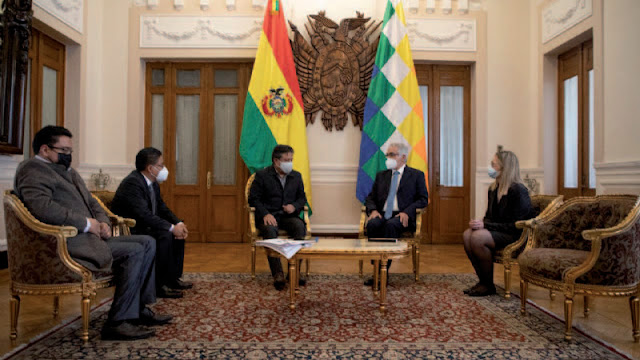
With a salute to the cameras, with his right hand and without giving statements to the press, García-Sayán began his agenda in Bolivia. This happened before entering a meeting with Foreign Minister Rogelio Mayta, scheduled for 9:00.
The meeting with the Minister of Foreign Affairs lasted approximately one hour. Afterwards, he went to the Vice-Presidency, where he held a meeting with the second in command of the country, David Choquehuanca. The meeting was also attended by the Minister of Justice, Iván Lima.
At approximately 3:00 p.m. he met with the Independent Jurists Group and at 7:00 p.m. with Conade leaders. These last two meetings were held in the facilities of the international organization in the country.
The former mayor and lawyer Juan Del Granado, representing the legal advisors, said that they delivered to the Rapporteur a dossier, in which they show that justice was subordinated to the three recent periods of government: to the current government of Luis Arce and to the administrations of Evo Morales and Jeanine Añez.
"We have been able to convey to the rapporteur the serious difficulties that our administration of justice is going through, with emphasis on the lack of independence (...). We have given him a complete dossier on the situation of judicial independence," he said.
For its part, Conade gave the UN rapporteur documentation showing that the justice system acted favorably in processes involving members of the MAS.
"We have exposed the lack of judicial independence, we exposed the most emblematic cases: from Tipnis, Fondioc, to cases of political persecution. We presented a registry of a list of judges who are linked to processes where the norms have not been complied with and the MAS was favored", indicated the representative of Conade, Lizeth Veramendi.
The head of the Creemos senators' bench, Centa Rek, and the Comunidad Ciudadana legislator Andrea Barrientos denounced that the opposition members of the Senate Constitution and Justice Commissions were not notified about today's meeting with García-Sayán. "This makes us see that in reality the agenda of the Rapporteur is being managed, trying to make only the official voices heard," he indicated.
García-Sayán is scheduled to have a meeting today with the presidents of the Senate and Deputies, Andrónico Rodríguez and Freddy Mamani.
"We are agreeing to the rapporteur's request (to meet) with the two presidents of both chambers," said Mamani.
Movimiento Al Socialismo senator Virginia Velasco confirmed that the Justice Commission will have a meeting with the rapporteur this Wednesday.
Guadalupe Cárdenas, during the demonstration held in the vicinity of the UN offices, said: "We have presented the letters (to meet with García-Sayán), so that everyone knows about the political persecutions".
The opposition benches of Comunidad Ciudadana and Creemos requested a meeting with the UN representative. Date and time have not yet been confirmed.
Former President Añez requested that he visit her in the Miraflores prison to explain her situation. "They have not yet confirmed the visit", explained Carolina Ribera, daughter of the ex-president.
Sources close to Añez's defense indicated that if the meeting is confirmed, it could take place during the weekend.
The leader of the Central Obrera Boliviana, Nicanor Baltazar, opened the possibility that the union also requests a meeting with García-Sayán, although he expressed that he "does not have much confidence" in the Rapporteur, because he was minister of his country, for which he expects him to be impartial.
The Bolivian executive will have to exploit 300,000 hours of content from TelevisaUnivision, in the future streaming platform that the company will launch.
At the beginning of February, Bolivian Marcelo Claure was announced as the vice president of TelevisaUnivision, the new company that was born from the merger between Televisa and Univision. A business in which the Mexican Televisa receives US$4,800 million, of which US$3,000 million would be in cash and the rest in shares, to become the majority shareholder, with a 45% stake in the nascent company.
The operation is also boosted by an investment of US$1 billion in shares purchased by SoftBank (a group in which Claure worked until mid-January 2022) and the current Univision investor, ForgeLight LLC. The executive is now part of a firm with tremendous potential that aims to conquer a market of 600 million Spanish speakers.
“TelevisaUnivision remains on track to launch, in 2022, its unified global streaming platform,” the company said in a statement issued at the end of January 2022. The new platform, the first large-scale one for the Spanish-speaking audience, aims to compete in the region with Netflix, Amazon, Disney+, Star +, Paramount + and Apple TV. To do this, you will have a free version and a premium version.
Televisa already tried something similar with its Blim platform in 2016, but it failed miserably. The nostalgia strategy, based on 13,000 hours of content, did not help him and as much as he tried to bring content like Cuna de Lobos to new generations, it did not work for him either.
In three years, the company relaunched the service under the name of Blim TV and added more than 30 live television channels to its content. In addition to the channels of Televisa Networks, Telemundo Internacional and Televisión Española. However, inside Televisa they know that the days of the platform are numbered.
One of Claure's tasks will be to exploit on the new platform the 300,000 hours of content available to TelevisaUnivision, as well as Televisa's four transmission channels, 27 pay television channels, the Videocine movie studio and the Univision and UniMás broadcast, nine Spanish-language cable networks, 59 TV stations, 57 radio stations and the PrendeTV AVOD platform.
"There are so many things to do I don't know where to start," Claure tweeted last week.
The competition that Claure will have to face will be tough, especially against Netflix. And it is that, in Latin America, Netflix, according to data from Statista, has 37.54 million paying users, a figure that represents 18.43% of its global subscribers. In the last two years, Netflix added 11.46 million new users; that is, 24.56% more than the number of new incorporations in the US and Canada.
Although the region is the one that generates the lowest average monthly income for the platform, with an average of US$7.12 per client, income from 2018 to 2020 grew by 35.65%, much more than services that they have money for content and a closed ecosystem closer to this type of audience, as is the case with Apple TV+.
Apple TV+ is an example of the challenge that TelevisaUnivision will face, since it is a company with money to invest in content, with a closed and faithful ecosystem that has not been able to convince users who demand content such as that available on Netflix or Disney +, according to experts.
The special rapporteur for the independence of judges and lawyers of the UN will begin his official activities from today in the country. He will meet with authorities and members of civil society.
After his arrival in Bolivia yesterday, the special rapporteur for the Independence of Judges and Lawyers of the United Nations, Diego García-Sayán, found that former president Jeanine Áñez and two activists opposed to the Government, who declared themselves political prisoners, are in hunger strike. In addition, he arrived in the country shortly after the scandal uncovered by the release of rapists and murderers sentenced to 30 years in prison and without the right to pardon by Bolivian judges.
Precisely today marks the seventh day of the voluntary fast in which former president Jeanine Áñez is found, imprisoned 11 months ago in the Miraflores prison, accused of incurring in an alleged coup in November 2019, when she assumed the Presidency after the resignation of Evo Morales, Vice President Álvaro García Linera and the heads of the Senate and Deputies. Áñez demands to defend herself from her in freedom and through a trial of responsibilities.
Through her legal defense, Áñez formalized the request for a hearing with the special rapporteur for the Independence of Judges and Lawyers of the United Nations.
The lawyer Alaín de Canedo explained that it will be the representative who decides whether or not to visit the former authority in the Miraflores prison, where he is serving almost a year of preventive detention “A meeting with the rapporteur has been requested, we understand that this has been accepted favorably.
It is up to Diego García-Sayán to set a day, time, the former president has expressly requested that she be visited in the Miraflores prison,” De Canedo said at a press conference.
The hunger strike was joined by the member of the Cochala Youth Resistance (RJC), Mario Antonio Bascopé, who is in preventive detention in the San Roque prison in Sucre, and assumes that his imprisonment is a "political revenge" for leading the protests against fraud in the 2019 elections, which led to the resignation and departure of former Bolivian President Evo Morales.
The former civic leader of Riberalta, Katriel Müller Justiniano also initiated the extreme measure "until the last consequences" in the prison of that city of Beni. He was imprisoned in November of last year after protesting the law against the legitimization of illicit profits, which was finally withdrawn from the Legislative Assembly by President Luis Arce Catacora.
Meanwhile, in recent weeks the case of femicide, murderer and serial rapist Richard Choque was uncovered. This man had been sentenced to 30 years in prison without the right to pardon for the kidnapping and murder in 2013 of a 20-year-old girl, Blanca Rubí Limachi.
At the end of 2019, the Judge of the First Criminal Execution of La Paz, Rafael Alcón, granted Choque house arrest because he presented a certificate that he had diabetes, good behavior, and because there was no fiscal objection. Later, the offender confessed that he sent the judge $3,000 and a bottle of whiskey.
The case has reached international relevance, because the Police discovered that he had killed and buried two other young girls in his own house, and also two men after he was released by Judge Alcón.
The Spanish newspaper El País reported that Choque confessed that he killed those women and raped more than 70. "His capture has also brought to light a network of corruption that supposedly affects judges for letting murderers go free," he said. The country.
In this context, the Judicial Council has so far detected at least five cases of sentenced persons who were released by former judge Rafael Alcón, three men and two women, and another 16 who received the same benefit in another court in La Paz. This is how justice is in Bolivia, and the facts jump out before the eyes of the United Nations envoy.
The Human Rights Watch (HRW) expert, César Muñoz, tweeted that “The UN rapporteur on judicial independence is visiting Bolivia. He will find, precisely, that there is no judicial independence. We urge you to support the work of Bolivian civil society in favor of justice without political interference”.
The former president and former president of the Supreme Court of Justice Eduardo Rodríguez Veltzé pointed out that, after the visit, García-Sayán must “report to the United Nations delegate for Human Rights, Michelle Bachelet. Then, this office, based in Geneva, must make its concern known to the relevant body, and if possible, let the General Assembly of the main multilateral body, the United Nations, know that it has a serious concern about the state of justice. in Bolivia, unless Diego García-Sayán finds another reality, but I don't think that's the case”.
For his part, the former Minister of Justice during the administration of Jorge Quiroga and member of the commission of notables for the transformation of justice, Carlos Goitia, hopes that “García-Sayán will come and reaffirm that justice in the country is not independent and give us an orientation on how it is that in other places or states these evils have been avoided, they have been corrected and democracies were strengthened based on these measures.”
The Minister of Justice, Iván Lima, admitted that this is why a judicial reform is proposed. “It is the State that we have inherited, it comes from the creation of the Judicial Branch. The criticism made by the rapporteur, when he finishes his work, will be the basis for the construction of a strategy that leads us to the solution of the problem”, he asserted.
He denounced, in an interview with the Influential program of EL DEBER Radio, that it is true that the International Group of Independent Experts (GIEI) concluded in its report that politics interferes with justice in the country, but that it was referring precisely to the government of Jeanine Añez. However, the GIEI stated in its report that political interference in justice is an evil that goes back much further and was a problem of the Morales government.
The agenda starts this morning. Vice President David Choquehuanca, Foreign Minister Rogelio Mayta and Minister Lima will welcome him. He will visit the presidents of both chambers and the Plural Justice commissions of the Senate and the Chamber of Deputies to collect impressions from the representatives of the country's political forces.
On Wednesday he will travel to Sucre where he will meet with the senior magistrates of the Judicial Branch and the State Attorney General's Office. On Friday, February 18, he will hold virtual meetings with members and judicial authorities from Santa Cruz, Oruro and Chuquisaca, it is not ruled out that he will do so with other regions.

Why is the US government offering Colonel Maximiliano Dávila a reward equal to the one it offered for “Chapo” Guzmán? Why was one of Dávila's alleged top lieutenants, former Major Omar Rojas, called the Bolivian "Pablo Escobar" by Colombian investigators? For more than 25 years, the alleged Bolivian drug traffickers have not made enough demerits to achieve such considerations. Moreover, in all that time, there was no more talk of "big fish" in drug trafficking in the country.
Thus, Dávila, former director of the Force to Fight Drug Trafficking, enters a select group of those most required by US justice. Not only the price assigned to him by one of the US reward programs is equal to that of the most important Mexican drug trafficker in recent years. The United States has also offered $5 million to anyone who gives information on, for example, Amir Muhammad Sa'id Abdal-Rahma al-Mawla. He is the second leader of the Islamic State of Iraq and Syria, better known as ISIS by its acronym in English.
Of course, when he was promoted to head of ISIS, the price of the data on Abdal-Rahma al-Mawla rose to 10 million dollars. In other words, Dávila seems to have been placed on a second or third rung of importance. Something like this also happened, for example, with the Venezuelan Maykel Moreno, president of the Court of Justice of that country, also valued at 5 million. While the price for Vice President Tareck El Aissami or for the President of the Venezuelan Congress, Diosdado Cabello, is 10 million.
For the Venezuelan president, Nicolás Maduro, the US offered, already in March 2020, 15 million dollars. Washington accused the Venezuelan president of directing the so-called Cartel de los Flores. It is not yet known who the US authorities place above Dávila in these narco-hierarchies. However, the US drug enforcement agency, DEA, slipped something into the reports of the agents who spoke with Dávila and Rojas. According to the DEA, Dávila and Rojas "described their extensive drug trafficking experiences and their connections to the highest levels of the Bolivian government." Dávila, it is worth noting, is the third former national director of the Special Force to Fight Drug Trafficking who falls for this crime.
The list of alleged drug traffickers and terrorists required by the US places Dávila alongside figures that seem very distant in space and causes. They are also there, for example, Muhammad Kawtharani, listed as a "high-ranking leader" of the Hezbollah forces and for whom they offer 10 million dollars. He has also offered monetary compensation of up to $15 million for information that could help disrupt the financial apparatus of Iran's Islamic Revolutionary Guard Corps and its fearsome Quds Force. And among these virtual “most wanted” by the first world power are two leaders of the remnants of the Revolutionary Armed Forces of Colombia (FARC): Seuxis Hernández Solarte, alias “Jesús Santrich”, and Luciano Marín Arango, better known as “Iván Marquez”.
However, the distances between Dávila and Rojas with Hezbollah, Iran and the Colombian guerrillas are shortened when considering the new cocaine routes. "Bolivia has become a kind of 'cocaine hub,' a drug concentrator," says Jaime Pérez (fictitious name), former parliamentarian and former authority, applied to security issues. From here, especially from the Cochabamba-Santa Cruz axis, Peruvian and Colombian cocaine, Paraguayan marijuana, and fine cocaine are also produced. Six main routes depart from Bolivia that feed the markets of neighboring countries and those that have been opened in recent years in other continents. (...) For this reason, the presence of "emissaries" has been verified, as Minister Carlos Romero said, from all the continental cartels. But, in addition, as various security organizations denounced, they added FARC guerrillas and militants from the Hezbollah organization as well as Iranian operators.
The Hezbollah terrorist group has been identified as one of the most used in the Middle East to produce and trade drugs. It is considered the wealthiest terrorist organization on the planet. Its main territory, the Bekaa Valley in Lebanon, is one of the largest opium and marijuana production areas in the world. Their drug trafficking routes are also directed towards Europe to obtain good profits. The DEA identified in 2016 a hierarchical structure within Hezbollah that has been in charge of its illicit operations since at least 2007. In addition, it has a direct logistics, business, and readiness relationship with Iran's Quds Force.
As early as June 2006, former DEA operations chief Michael Braun assured US lawmakers that Hezbollah was "moving tons of cocaine" from South America to Europe and that it had developed one of the "most sophisticated that has ever been seen. Apparently, with the scheme fully consolidated, the most recent DEA reports have indicated that businesses with Latino mafias were identified. They cite the Los Zetas cartel from Mexico and the Oficina de Envigado from Colombia. In addition, it is claimed that Hezbollah operators sealed agreements with the National Liberation Army (ELN) and the residual FARC.
Starting in 2006, on several occasions, reports of the presence of Iranian and Hezbollah operators in Bolivia arose. For example, on May 17, 2012, the Italian newspaper “Corriere della Sera” published a report on the presence of the Lebanese terrorist group in Bolivia, Brazil and Colombia. It also pointed out that the intelligence services of Latin America "raised their alert levels" due to that presence. During those years, a growing and controversial presence of high-level Iranian operators also drew attention in Bolivia.
On February 18, 2011, the Iranian Government Minister, Ahmad Vahidí, arrived in Bolivia. He came nothing less than to participate in the inauguration of the Defense School of the Bolivarian Alliance located in Santa Cruz. The fact unleashed a diplomatic conflict of proportions with Argentina due to the remarkable profile of Vahidí. He had been head of the Quds Force when the attack was perpetrated on July 18, 1994 against the Asociación Mutual Israelita Argentina (AMIA) that caused 85 deaths.
In November 2006, the Argentine federal judge Rodolfo Canicoba Corral considered him one of the masterminds behind the attack in Buenos Aires. That attack was orchestrated both by the Quds force and by its inseparable partner Hezbollah. The investigations of the prosecutor Alberto Nisman (who died in 2015 by presumed suicide) described Vahidí's conduct in that attack in detail. Five months ago Ahmad Vahidí was ratified as Minister of Government by the new Iranian government.
The Iranian-Lebanese connection also reached Colombia significantly. The American analyst Joseph M. Humire, in an article published in November in various international media, has indicated: “Within the files recovered in October 2020 by the Colombian Army on the computer of the assassinated ELN commander, alias Uriel, they revealed audios saying that in Iran "they are very open" to providing the ELN with paid trips to receive training. Later, on July 29, 2021, the Colombian Army seized another computer, but this time from the leader of the FARC dissidents, alias Gentil Duarte, where they discovered communications from last December, declaring that the dissidents had established "diplomatic relations" with Iran".
Later Humire, a security specialist, adds that the FARC and Hezbollah have a long history of collaboration. This dates from the attack on the AMIA. It was then found that a Colombian named Salman Raouf Salman, acting as a Hezbollah operative, worked with the FARC to smuggle explosives from Lebanon into the tri-border area for use in the attack in Argentina. He then adds more examples of collaboration between the two terrorist groups going back to recent years.
The new revelations had such an effect that Colombian Defense Minister Diego Molano declared in November 2021 that Iran and Hezbollah are enemies of his country. And if that is how they were felt in Colombia, Venezuela and even further north, they have also left an undeniable trail to the south. More precisely, the cells of the Islamic organization have been located in the Paraguayan Ciudad del Este, where the triple border with Argentina and Brazil is located. And to unite these two South American extremes, the most direct, least protected and most functional route of all is Peru-Bolivia-Paraguay, with Bolivia as the strategic axis. An axis that the analyst Manuel Morales Álvarez has highlighted that "allowed the globalization of the cocaine markets by reaching other continents."
"They come from Colombia and the central highlands of Peru to the 'kitchens', where the base paste is purified, located around Santa Cruz de la Sierra, in Bolivia - journalist Gustavo Sierra has written in a report on Hezbollah for the Infobae portal -. From there they go to Paraguay. They easily reach Ciudad del Este, cross the Friendship Bridge to Foz do Iguaçu to São Paulo, in Brazil, and the Tancredo Neves Bridge to Puerto Iguazú in Argentina. From the missionary city, the Paraná does the rest. The cocaine goes down in barges to the ports around Rosario or goes directly to Buenos Aires where ships full of soy await to camouflage the cargo that will give them the greatest profits.
The text emphasizes the importance of a place as strategic as that of the Triple Frontier. “Right now the two big Brazilian cartels, the First Command of the Capital (PCC) and the Comando Vermelho (CV) are fighting it - adds Sierra-. But there are also other players involved in the business, from Bolivian and Paraguayan groups to Lebanese Hezbollah agents who send shipments to their own organizations in Europe, the Middle East and Asia.”
And it is precisely on that route in time and space that is so Hezbollain and Iranian where Dávila and Rojas fit. The Bolivian cartel, with its respective "Chapo" and "Pablo Escobar", caught the attention of DEA agents for its scope and boast of power. In fact, the skein began to unravel in March 2021 when Rojas was captured in Colombia.
The organization of Dávila, Rojas and those who are their superiors, in parallel with Hezbollah and Quds, jumps from the South American to the continental.
"In recent years, the US had somewhat relaxed its pressure on Bolivia because the cocaine that left the country basically went to Brazil," Pérez says. But, suddenly, a kind of Bolivian cartel emerges with central operators like Rojas and Dávila, associated with an old big shot like 'Techo 'e Paja' Roca who have opened routes to the United States. It was reported that Rojas met with people from the ELN and the FARC and that Dávila practically controlled Bolivian territory. His ‘services’, as cited by the Colombian revelation, include drugs, planes, protection and arms sales.”
In other words, the Hezbollah route with an addition: there is talk of a strange arms trade to a country where the sale of arms is free. There is talk of protection and provision of machine guns at a time when these services were provided by partner organizations. A mega-scandal that suddenly turned Bolivian politicians upside down and opened up a wave of questions with unpredictable answers.
Are the coincidences between the route of Dávila and Rojas with the operations of Hezbollah just that, something stronger or much more? Which Bolivian partners do Hezbollah operators support their work in the strategic Bolivian corridor? Will Dávila be extradited, today detained in Bolivia accused of legitimizing illicit profits? Are the new DEA operations the result of the confessions of Venezuelan and Bolivian operators (including former Minister Arturo Murillo) recently detained in the US? Do the DEA and other US intelligence agencies have already identified the bosses of Dávila and Rojas?

The Executive President of YPFB, Armin Dorgathen, asserted this Wednesday that Luis Marcelo Arce Mosqueira, son of President Luis Arce Catacora, worked at the state company until September of last year and denied that the young man had a salary of 50,000 Bolivians.
“It is false that the president's son Luis Arce has at some point earned 50,000 bolivianos within YPFB or some subsidiary of YPFB. The President's son is a young professional who has never held managerial positions. He was always in technical positions and worked until September 2021, when he voluntarily resigned from his job at YPFB Corporación”, Dorgathen indicated.
The executive added that Arce Mosqueira "is an industrial engineer with a Master's degree in Hydrocarbon Processes and has more than 10 years of experience in the hydrocarbons industry and area."
The statements were made after versions emerged that Arce Mosqueira held management positions with a salary of 50,000 Bolivians.

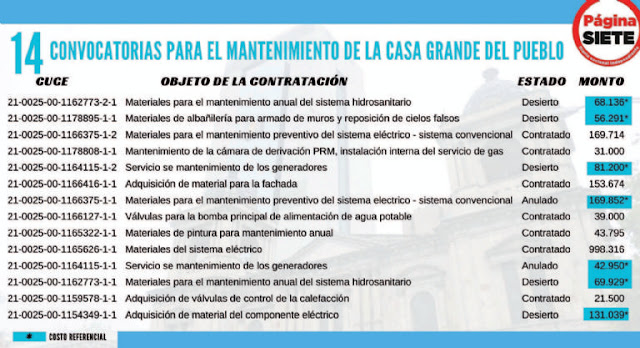
During 2021, 14 processes were published in the State Procurement System for the purchase of spare parts, but only seven were awarded. The rest were declared void or were annulled.
After four years of its opening, and two of neglect, part of the maintenance of the Casa Grande del Pueblo costs 1.5 million bolivianos. This figure does not include the contracts that are still pending, those that have been canceled and some that have been declared void.
Between August and December 2021, the Ministry of the Presidency published, in the State Contracting System (Sicoes), 14 contracts referring to the maintenance of government infrastructure. Of these, seven were awarded and six were declared void or canceled from the call.
The purpose of the contract is the purchase of supplies for the maintenance of the electrical system, the hydro-sanitary system, the façade or the heating. The number of contracts and their value is lower compared to those made in 2019, when all the floors and offices of the building were still equipped and put into operation.
Although the building is still new, it is highly used and already generates several complaints. Some of them are due to the detachment of the facade and certain damage to the hydro-sanitary system.
The government building was inaugurated on August 8, 2018. Its construction was declared a national priority in 2012, through Law 313. The contract that began the works, in 2015, stipulated that the 29-story building and a heliport should be delivered in 2016.
However, the terms and costs changed in five modified contracts. Between the first and the last there is a difference of 9.9 million Bolivians.
For its equipment and decoration, more than 34 million Bolivians were allocated. The amount included a bed of more than 21,000 bolivianos and dishes of more than 33,000.
The then president, Evo Morales, promoter of the project, occupied the presidential floor and governed from that building until his resignation in 2019.
After his departure, former temporary president Jeanine Añez decided to return the presidential offices and rooms to the former Government Palace and the San Jorge residence, respectively. Only the floors that housed five ministries remained in operation.
It was during the hard times of the pandemic that it was decided to install a control and coordination center for the fight against covid in Morales' suite, and on floors 22 and 23.
From the beginning of the transition in November 2019, until its departure in November 2020, there were no purchases of supplies or services for maintenance.
These were not taken up again until the second half of 2021, during the Luis Arce administration. The president returned the presidential offices to the new premises. It should be noted that Arce does not reside in the suite of the Casa Grande del Pueblo or in the residence of San Jorge. He preferred to keep his home in Miraflores, within the framework of his austerity policy.
After four years of its opening, and two of neglect, part of the maintenance of the Casa Grande del Pueblo costs 1.5 million bolivianos. This figure does not include the contracts that are still pending, those that have been canceled and some that have been declared void.
Between August and December 2021, the Ministry of the Presidency published, in the State Contracting System (Sicoes), 14 contracts referring to the maintenance of government infrastructure. Of these, seven were awarded and six were declared void or canceled from the call.
The purpose of the contract is the purchase of supplies for the maintenance of the electrical system, the hydro-sanitary system, the façade or the heating. The number of contracts and their value is lower compared to those made in 2019, when all the floors and offices of the building were still equipped and put into operation.
Although the building is still new, it is highly used and already generates several complaints. Some of them are due to the detachment of the facade and certain damage to the hydro-sanitary system.
The government building was inaugurated on August 8, 2018. Its construction was declared a national priority in 2012, through Law 313. The contract that began the works, in 2015, stipulated that the 29-story building and a heliport should be delivered in 2016 .
However, the terms and costs changed in five modified contracts. Between the first and the last there is a difference of 9.9 million Bolivians.
For its equipment and decoration, more than 34 million Bolivians were allocated. The amount included a bed of more than 21,000 bolivianos and dishes of more than 33,000.
The then president, Evo Morales, promoter of the project, occupied the presidential floor and governed from that building until his resignation in 2019.
After his departure from him, former temporary president Jeanine Añez decided to return the presidential offices and rooms to the former Government Palace and the San Jorge residence, respectively. Only the floors that housed five ministries remained in operation.
It was during the hard times of the pandemic that it was decided to install a control and coordination center for the fight against covid in Morales' suite, and on floors 22 and 23.
From the beginning of the transition in November 2019, until his departure from him in November 2020, there were no purchases of supplies or services for maintenance.
These were not taken up again until the second half of 2021, during the Luis Arce administration. The president returned the presidential offices to the new premises. It should be noted that Arce does not reside in the suite of the Casa Grande del Pueblo or in the residence of San Jorge. He preferred to keep his home in Miraflores, within the framework of his austerity policy.
The CEO of Venqis supported the MAS campaign and is related to Marcelo Arce, advisor to YPFB Chaco. The Panamanian firm is fighting to be awarded the gas exploitation strategy in a protected area.
A commission of opposition deputies is investigating the Panamanian company Venqis SA, which seeks to be awarded the communication strategy for the YPFB Chaco project “Astillero X1”, a gas well in a protected area of Tarija. The director of the firm, the Brazilian Andre Golabek, who faced legal proceedings in his country and in Panama, supported the electoral campaign of Luis Arce. The investigation will extend to the President's son, Marcelo Arce Mosqueira, current advisor to YPFB Chaco.
In a letter addressed to that state company, dated July 2, 2021, Golabek presents his company: “At Venqis SA we have been developing our experience in institutional communication in several countries, highlighting political strategies, management of government organizations and their interaction with citizens, as well as crisis management at the local level”, says the note.
This letter accompanies the proposal presented by the Panamanian firm for the LS-2021-40 process "Services for the production and dissemination of communication products for the Shipyard area", convened by YPFB Chaco, for the preparation of a campaign that counteracts the voices criticism of the exploitation of hydrocarbons in the protected area of Tariquía.
Venqis's proposal included a Communication strategy, two audiovisuals for TV, four videos for social networks, six digital graphics products, including the dissemination of products for three months and payment to the work team, budgeted 1,271,440 bolivianos, equivalent to 184,700 dollars, exactly the same amount stated in the specification document that YPFB Chaco published three days later.
The applicant company also fully coincided with the components that the contracting party had considered. “The LS-2021-40 process was not awarded to Venqis. It was not awarded and it has already ended, without contracting, ”said the YPFB communication director, Óscar Salazar, in a brief contact with Página Siete.
However, the background of the participation of the CEO of Venqis in the electoral campaign of Luis Arce, added to complaints of previous hirings to the Panamanian company, which are denied by YPFB Chaco, raised doubts in the Tarija opposition deputies.
“We are forming a commission of opposition parliamentarians; however, we are also sending a letter to the president of the Chamber of Deputies, Mr. Freddy Mamani, so that a commission can also be formed in the Legislative Assembly, understanding that the Venqis company has supported Luis Arce's campaign at the time and there is a feeling that this was a political favor that is intended to be paid with the money of all Bolivians,” Tarijeña deputy Luciana Campero (CC) told Page Seven.
The assemblywoman pointed out the similarities of this Panamanian company with the Mexican Neurona Consulting that between 2017 and 2018, during the administration of Evo Morales, was awarded direct contracts for 12.4 million Bolivians for communication campaigns.
For the case, a process was opened for corruption and economic damage to the State that, finally, was dismissed in the Bolivian justice without clues about those responsible for the payments.
“46 political campaigns and successful institutional changes in the last five years”, is how the company Venqis SA presents itself, on its official website. It promotes four specialty units: leadership, elections, institutional, and technology and intelligence. According to the site, the firm has offices in Spain, the Dominican Republic and Panama.
Data from the Public Registry of Panama show that the company was created on September 7, 2015. Three people appear on the board of the company: Andre Golabek, as president; Georgina-Amalia Jianu, secretary; and Tatiana Cristina Núñez Barreno, treasurer.
However, the same Registry records in 2019 the dismissal of Golabek as president of Venqis, together with the director and the treasurer. The date coincides with the investigation of the company for irregular awarding of contracts in Panama.
The Panamanian newspaper La Prensa described Venqis SA as "a company friendly to the ruling Democratic Revolutionary Party (PRD)" and reported that the firm benefited from contracts from various state institutions totaling at least $658,000, all of them for products communication and advertising.
The director of Venqis, André Golabek Sánchez, for his part, faced 15 legal proceedings in Brazil in the last decade, according to the specialized portal Jusbrasil. Most of them are labor and tax lawsuits; but there are two penalties in the registry for extrajudicial execution of title. Page Seven insisted on knowing the businessman's version, but did not respond to the requirements.
Speaking to the newspaper El Deber, Andre Golabek admitted having worked on Luis Arce's election campaign. The strategist said that he supported “like so many people who believe in the government proposal of President Luis Arce. We weren't really hired by anyone. It was a contribution from capable people who are committed to a political project.”
Asked about Golabek's participation in the MAS campaign, Marianela Paco assured that she has no reference. "I worked alone with the militancy," she told Page Seven.
Other sources within MAS agree that neither the Brazilian strategist nor the firm Venqis worked on Luis Arce's campaign. The sudden appearance of the Brazilian businessman once the elections have been won, they say, causes annoyance in the bases and they were the ones who uncovered the case.
His version is that the strategist came to YPFB Chaco through a friendly relationship with the President's son, Marcelo Arce Mosqueira, who worked and is currently an advisor at the state company. Golabek, however, denied this situation.
The commission of deputies that investigates the Brazilian strategist and Venqis also includes Arce Mosqueira, as announced by deputy Campero.
Luis Marcelo, the eldest son of President Luis Arce, worked until 2021 at YPFB's headquarters and then moved to YPFB Chaco. In both he held managerial positions, admitted the spokesman for the state company, Juan Carlos Ortiz, on Monday.
After the denunciations of nepotism of union leaders and trustees of YPFB, presented by the pro-government deputy Rolando Cuéllar, the CC bench announced that it will request a report from the oil company.
Venqis The company Venqis was created on September 7, 2015, according to the Public Registry of Panama.
Areas The company has four units: leadership, elections, institutional, and technology and intelligence, according to its website.
Offices Its official site says that the firm has offices in Spain, the Dominican Republic and Panama.
Panama The firm was benefited with contracts from Panamanian state institutions for at least 658 thousand dollars, according to local media. It was investigated.
CEO The director of Venqis is the Brazilian Andre Golabek Sánchez, who faced 15 legal processes in his country in the last decade.

He only receives visits from his lawyers. After complaining, she was allowed to receive a visit from her relatives the next week. Her daughter denounces that prison doctors are insensitive.
With broken health and incommunicado, this is how former president Jeanine Áñez completes her fourth day of hunger strike in the Miraflores prison in La Paz. The former president took the extreme measure in the face of the announcements of trials and the unfavorable rulings against her by the justice system, which accuses her of carrying out a coup against former President Evo Morales, who resigned in 2019 overwhelmed by the social conflicts that erupted after indications of fraud in the elections of that year.
In an interview on the program ¡Qué Semana!, which is broadcast every Saturday on EL DEBER Radio, Carolina Ribera Áñez -daughter of the former president- reported that Áñez is isolated in her cell without being able to receive a visit from any family member.
The most unfortunate, according to Ribera, is the deteriorated state of health of her mother and the isolation to which she has been subjected by the Penitentiary Regime. In fact, the only contact that the former president has is with her lawyers, who reported on the deteriorating state of health of Jeanine Áñez.
“My mother begins her fourth day of hunger strike, I have not been able to see her. She remains firm and determined; She is not going to live in a country where injustice and abuse of power prevail, despite her delicate health situation, ”said Ribera.
The daughter of the former head of state also denounced that the Penitentiary Regime does not allow her to see her mother, which generates mistrust about her health. “Doctors are insensitive, they lie without batting an eyelid. God grant that they prioritize my mother's health. She is totally incommunicado, she only sees her lawyers, ”said the young woman.
During the conflicts of 2019 that arose due to indications of fraud in the elections of that year, Áñez took the reins of the State through constitutional succession, after the resignation of Evo Morales. However, when leaving power, the former authority denounced a coup d'état forged by civic leaders, police and military.
Morales' resignation occurred on November 10, 2019. For two days there was a power vacuum and after several negotiations that included supporters of the MAS, the constitutional succession of Áñez was agreed, who took the reins of the country on November 12. month.
Before that, she did not participate in any protest activities. Her rise to power came as a surprise even to her own party, which did not count her on the security list in that year's elections. She was a senator for Beni, and as the second vice president of the Bolivian Chamber of Senators, she came to power by constitutional succession.
However, the government that is in the hands of the Movement Towards Socialism (MAS), questioned this process, even accused it of being part of the so-called coup d'état, a story that the ruling party has tried to impose since it regained power in the elections of 2020. In this sense, it initiated processes against all the former authorities of the transitional government, including Áñez.

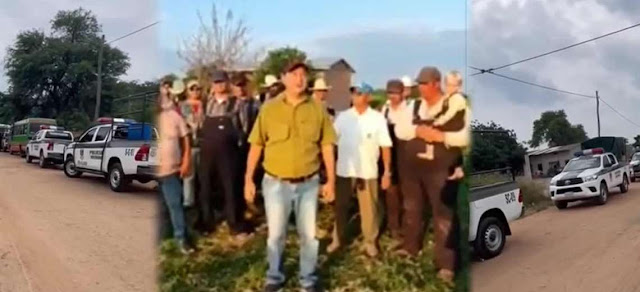
The commission of prosecutors investigating the Las Londras case presented the formal accusation against Paulino Camacho Vedia, identified as the "most dangerous" of the armed group, and asked that he be sent preventively to the Palmasola prison, considering that there are sufficient elements for the kidnapping of civilians at the Las Londras estate, in Guarayos (Santa Cruz).
Camacho Vedia is the second apprehended in the case a little over three months after the ambush, Hebert Sixto Canaza Sacaca was the first person to be captured for the kidnapping of 17 people.
According to the local media report from Santa Cruz, Camacho was apprehended around noon near the bimodal terminal. He already had an arrest warrant.
The accused was transferred to cells of the Special Force to Fight Crime (Felcc) and last night, when he was due to testify, he decided to avail himself of his right to remain silent before prosecutor Wálter Cisneros, a member of the commission investigating the kidnapping on the property. The Londons.
The accusation against Paulino Camacho was prepared by the prosecutors' commission, made up of Cisneros, Delmy Guzmán and Osvaldo Tejerina, and presented this Saturday before the court on duty, to set a date and time for the precautionary hearing, according to El Deber.
The crimes for which the defendant is accused are: serious and minor injuries, deprivation of liberty, aggravated robbery, possession or carrying of a firearm, attempted homicide and threats.

